
NEWS REPRINT
Lauderdale Hurts for Dockspace
as Big Boats Grow in Numbers
Released Thursday, April 1, 2001
by Joseph Mann
Copyright © Sun-Sentinel, 2001
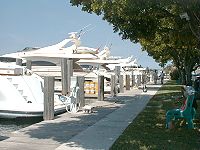 Yachts come from all over the world to visit Fort Lauderdale. But some of them are having a hard time finding a parking space.
Marinas and boat repair yards -- key elements in the recreational marine sector that generates billions of dollars in business each year for the city and for Broward County as a whole -- have been fighting a losing battle for space against real estate developers, zoning rules and complex permitting procedures.
And despite rising demand for new dock space -- especially for "megayachts," or luxury boats measuring 80 feet or greater -- construction and expansion of marinas and boatyards along Broward County's 300 miles of waterways is lagging. This is chiefly because of a shortage of available space, expensive waterfront land that can reach $1 million an acre or more and high costs for dredging, construction and environmental compliance.
"We're the yachting capital of the world, and the sad fact is, we're running out of docking space," said Frank Herhold, executive director of the Marine Industries Association of South Florida, a trade group whose 800 members include marinas, boat repair yards, boat manufacturers and a host of related businesses.
Over the years, he explained, some marinas (which usually are for docking and storage) and boatyards (where owners can maintain, repair and refit their vessels) sold out to developers, while others disappeared as big companies gobbled up smaller ones. Currently, there are about 148 marinas in the Greater Fort Lauderdale area and some 35 boat repair yards in Broward, according to industry estimates.
"But boats keep coming to Fort Lauderdale from all over, and they keep getting bigger," Herhold added.
"Megayachts mean big business for Broward. If they can't find space here, they could go to the competition in Jacksonville, Savanna, the Bahamas, Charleston, Mobile or Tampa."
Megayachts -- which can cost anywhere from a few million dollars to more than $200 million -- often spend more than $200,000 each when they visit the area, including items such as boatyard expenditures, repairs and new equipment, purchases of goods and services and others, according to marine industry estimates. And this translates into more than $500,000 in overall economic output per visit.
Many of these large vessels are based here. Hundreds more visit Fort Lauderdale each year from other parts of the United States and from other countries.
Heaviest season
Jamie Hart, who manages three marinas for the city of Fort Lauderdale, has 200 slips to accommodate large and small pleasure vessels, and says he needs more. "I could build another 50 slips for megayachts, and it wouldn't be any trouble filling them up during high season," he said. High season, running from around Oct. 15 to April 15, is the period of heaviest yacht traffic in South Florida, he noted.
But space is at a premium. "In the city of Fort Lauderdale, there's really only a small amount of commercial real estate available on the water," said Ted Drum, one of the owners of Drum Realty. Most waterfront property is residential, he said, and it would be hard to convince local authorities to rezone much of that land to allow marinas and boatyards.
Moreover, he added, because of high land values and environmental issues, "it's too expensive and too demanding to build marine properties."
Just acquiring an existing property is an expensive proposition. Drum's real estate company, for example, is negotiating the sale of a marina with 150 feet of waterfront on 17th Street in Fort Lauderdale. The 2.5-acre facility, which hauls boats out of the water and stores them onsite, carries an asking price of $6.5 million.
Some people are adding dock space, but new construction and expansions are pricey -- and complex -- undertakings.
Marina Mile Shipyard Inc. in Fort Lauderdale, which handles maintenance, repairs and refits for megayachts only, plans to invest $30 to $40 million over the next three to four years to expand existing facilities along the New River and accommodate more yachts. L. "Lee" Miller, Marina Mile's director, said his company acquired 12 acres adjacent to its existing six acres, which will raise megayacht repair and storage capacity from the current level of 18 vessels to 42 to meet strong demand. The additional property cost "somewhere north of $1 million an acre," he added.
"Most of our customers are regulars and come back year after year," he said. "Our slips are full and I have to turn away around two boats a week that are looking for repairs."
Currently Marina Mile is carrying out a multimillion dollar refit on Quiet Place, a 156-foot yacht, and is docking Reef Chief, a 120- foot vessel and Mamosa, a 132-foot boat scheduled to sail for the Mediterranean.
Regardless of length, megayachts at Marina Mile typically spend $300 to $500 a day in docking fees. "It's like a hotel room," Miller said. "When you put one person in a room, it's occupied." These fees include dock space, use of some shipyard equipment, drinking water, trash pickup, security, a daily newspaper and other amenities. Work done on the craft, food, beverages, special equipment and other items are extra.
Welter of regulations
Aside from making a large investment, Miller has to comply with a welter of regulations. He said he needs 11 licenses and permits, three management plans -- for disposing of chemical wastes, for use of controlled chemical substances and for controlling pollution while recoating boats -- and seven different forms of risk insurance ranging from property damage to personal liability for owners, captains, crew and vendors in the yard.
He also has to be careful to comply with zoning classifications and city and county regulations, and must develop additional plans for the Occupational Safety and Health Administration, the Environmental Protection Administration and Florida's Department of Environmental Protection.
Stiles Corp. recently invested about $1.5 million to build a public marina capable of handling up to 22 megayachts on the Intracoastal Waterway. But the relatively low price tag refers to construction work alone. Stiles already owned the waterfront property where the marina was built since it's attached to the $65 million Sunrise Harbor mixed-use community the company developed off Sunrise Boulevard.
Chinnock Marine Inc., a service and repair yard that handles boats up to 85 feet long, is selling its 2.5-acre plot on the New River to a developer, but thinks it can find a new place to relocate, said owner Phillip Chinnock. Chinnock, whose yard has been in business almost 20 years, was lucky to find available space that was zoned for commercial use. He is negotiating for an 8- to 12-acre property. "The big problem is getting it at the right price," he said.
If the deal is a success, Chinnock expects to add 15 to 20 employees to his present payroll of 63 and handle more boats at the new site.
Project on hold
One potential megayacht project, linked to a 27-acre stretch of waterfront land in Port Everglades, is on hold. The port asked for letters of intent from private developers interested in building a megayacht repair yard there, explained Larry Strain, assistant to the port's director. But the Broward County Commission has delayed a decision until negotiations are concluded with Florida East Coast Railway on construction of a freight container transfer facility that could extend into the 27-acre parcel.
While these and some smaller projects will help ease the space shortage, and should ensure Fort Lauderdale's future as an international yachting center, they probably won't be able to fully meet demand from a growing number of megayachts, industry sources say.
Jim Gilbert, editor-in-chief of ShowBoats International, a Fort Lauderdale-based magazine devoted to megayachts, said there are about 5,000 of these huge pleasure craft in the world, and "we're adding around 250 megayachts per year."
He estimates that about one-fifth of the world's luxury fleet comes through South Florida every year. Fort Lauderdale continues to attract these vessels because of its location, warm weather, international reputation for service and other characteristics.
Besides, it's a great place for megayacht owners to live, he added. "How many places in the world can you dock your 100-foot boat in the back of your house?"
Close Window